

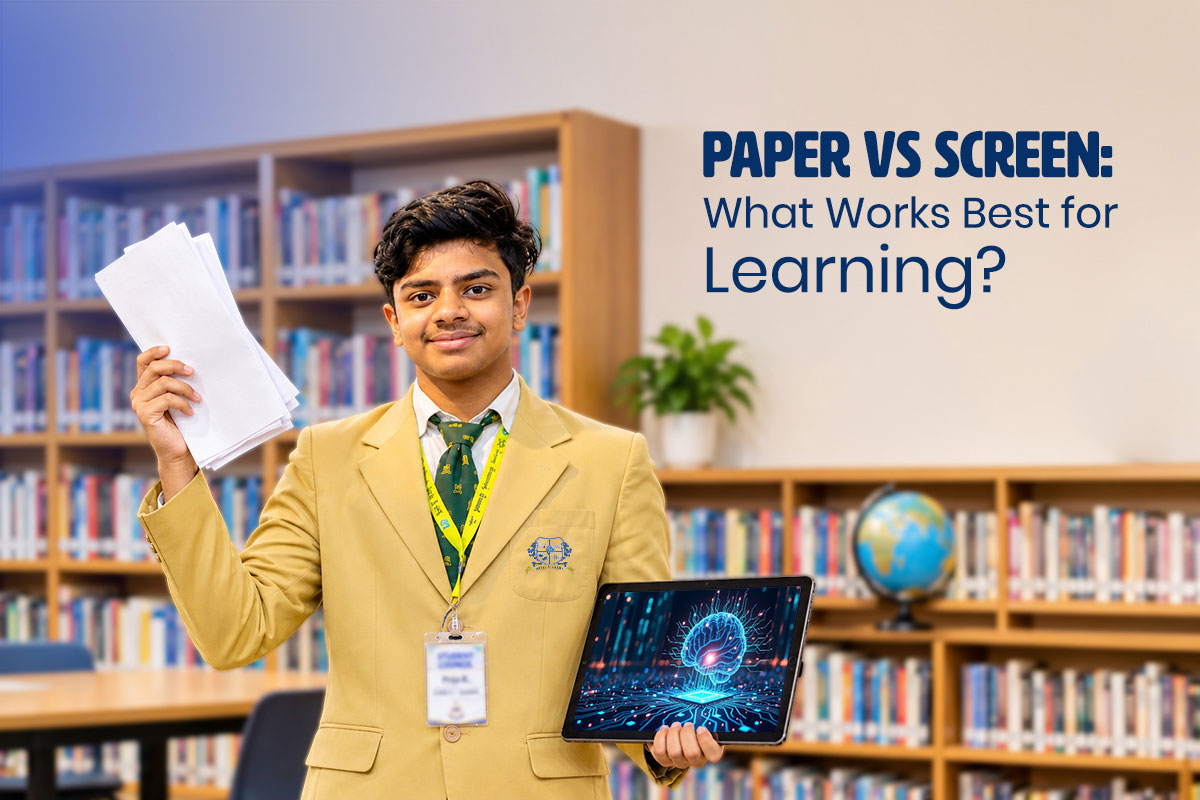
Paper vs Screen: What Works Best for Learning?
11-11-2026Walk into any classroom today and you will see two worlds side by side: one student highlighting a textbook, another swiping through a tablet. As digital learning for students becomes the norm, parents and teachers keep asking the same question. Do students learn better on paper or on screens? The digital learning vs traditional learning debate has no simple winner, but the honest answer is more interesting, and it can change the way your child studies.
Let us begin with paper, because the research here is quite striking. Many studies on reading comprehension suggest that readers often understand and remember long, informational texts better when they read them in print. This is one of the key benefits of paper-based learning. A printed book gives the brain physical anchors, such as the left page, the top corner and the thickness of the pages already read. These cues help build a mental map of the material, which makes it easier to recall where an idea appeared. A book also never sends notifications, so it protects the sustained focus that deep learning depends on. Paper encourages a slower, more careful pace. Handwriting adds to this. Writing notes by hand forces students to summarise ideas in their own words, which strengthens understanding, whereas typing is faster but often tempts them to copy rather than think.
Screens, however, win in many situations. One tablet can hold thousands of books, which matters enormously for students who cannot afford expensive textbooks or live far from a library. Simulations, videos, quizzes and instant feedback bring science, maths and languages to life in ways static pages cannot. Adjustable font sizes, text-to-speech and translation tools make learning more inclusive for students with dyslexia, visual impairments or different language backgrounds, which is something we deeply value in a classroom as varied as ours. And when it comes to revision and research, finding a single concept in a 500-page document takes only seconds.
At The Royal Academy Ajman, a CBSE school in Ajman, we see this balance every day. Our students come from many nationalities and cultures, and as the first Indian school to welcome such a diverse community, we have learned that no two learners are alike. Some thrive with a printed page and a highlighter, others with an interactive simulation. That is why our approach to the best Indian education follows the CBSE curriculum with a thoughtful blend of both, rather than choosing sides in the digital learning vs traditional learning conversation.
So which one wins? Neither, by itself. When it comes to paper vs screen learning, the research suggests that the task and the learner matter more than the medium. Paper works best for long-form reading, unfamiliar or difficult concepts, deep study and note-taking meant to build understanding. Screens work best for research, practice quizzes, multimedia lessons, collaboration and quick reference. How we use each one matters just as much as which one we choose. A student who reads a PDF with notifications off and takes thoughtful notes may learn far more than one who skims a printed page while half asleep.
For families wondering where to start, a few habits make a real difference. Print the chapters that matter most, especially dense ones or those needed for exam preparation. When working on a screen, switch on focus mode, silence notifications and keep just one tab open. Annotate actively, whether with a highlighter or a stylus, so that the text is something your child interacts with rather than simply scrolls past. Mixing methods works beautifully too: watch a video to see the big picture, then read on paper to go deeper. And do not forget the eyes. The 20-20-20 rule is an easy one to follow, so every twenty minutes, look at something twenty feet away for twenty seconds.
In the end, the debate between paper and screen is really a question of purpose. Paper tends to support deep focus and memory, while screens offer access, interactivity and flexibility. The best learners and the best classrooms use both, choosing the right tool for the job. So, the next time your child sits down to study, ask: what are we trying to learn, and which format will help us do it best?